



HDPE pipe PE100 DN250 PN16
PE100, SDR 11 pipe for mining pipelines, slurry transport, and pressurized networks.
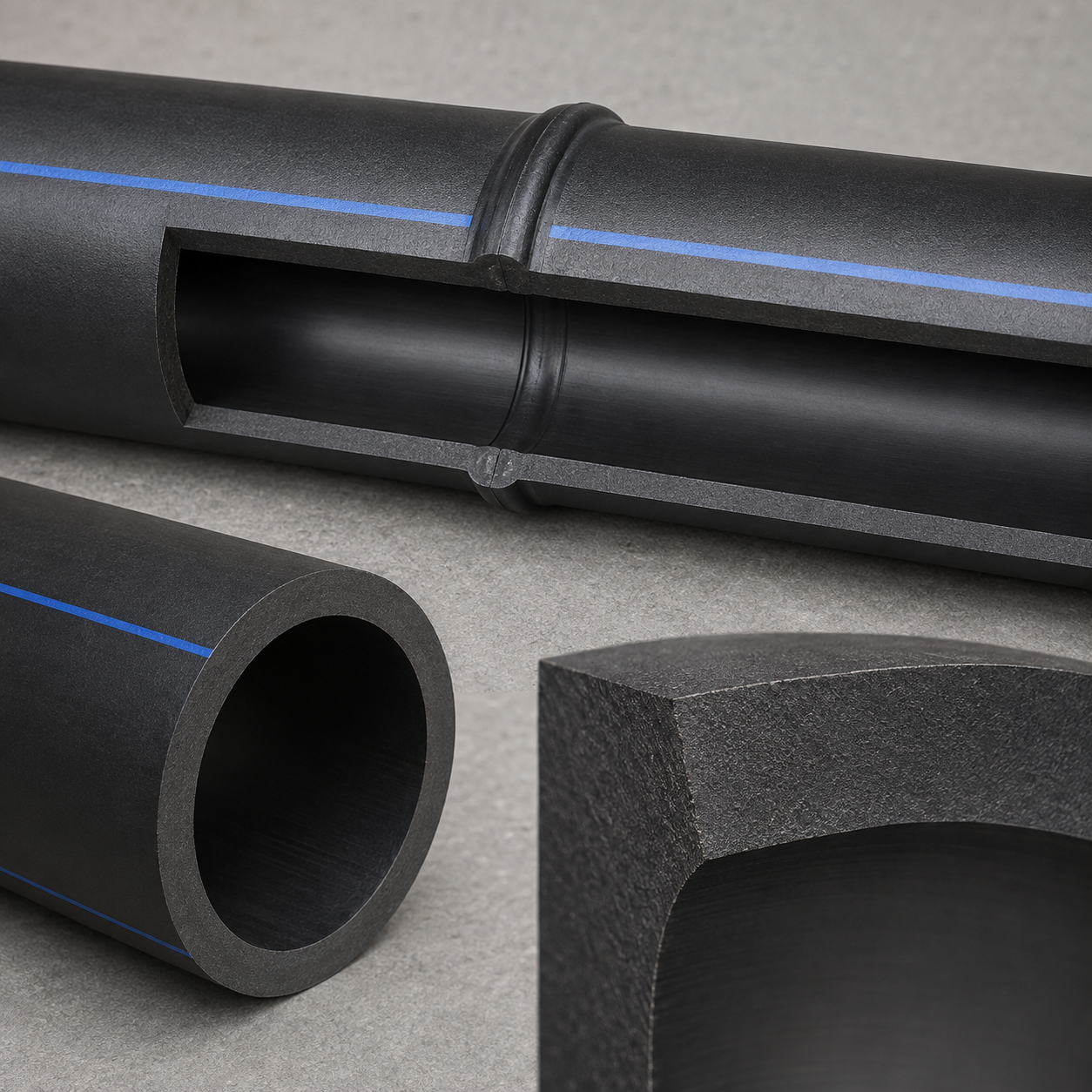
HDPE pipe · TH-02
Technical description
The HDPE PE100 DN250 PN16 pipe is used in pressurized lines requiring a larger diameter and wall thickness. It can form part of water pumping lines, process networks, slurry transport, and mining pipelines when the material is compatible with the fluid and hydraulic conditions. Its SDR 11 dimensional ratio is associated with the stated pressure classification.
Polyethylene provides corrosion and abrasion resistance, flexibility under moderate movement, and continuity through fused joints. However, pipe selection is not based only on diameter and PN. Flow, velocity, head loss, temperature, water hammer, vacuum, transported solids, and design life determine the configuration. Valves, flanges, branches, crossings, and fabricated pieces must also be reviewed.
Reference sheet
Specifications
- Material
- PE100 (MRS 10 MPa)
- Nominal diameter
- 250 mm
- Nominal pressure
- 16 bar (SDR 11)
- Wall thickness
- 22.7 mm
- Dimensional standard
- ISO 4427 / ISO 4437
Use criteria
Recommended application
Mining pipelines, slurry transport, thickened tailings, pressurized industrial water networks, and long-distance drainage.
When the line integrates with existing equipment, elevations, connections, and installation restrictions must be identified. This helps anticipate spool pieces, reducers, or branches before fusion equipment is mobilized.
Relevant characteristics
Product contribution
- Capacity for pressurized networks.
- Continuous joints through butt fusion.
- Application in mining and industrial conveyance.
Typical uses
System applications
- Mining pipelines
- Process networks
- Slurry transport
- Water pumping lines
Selection criteria
Required information
- Hydraulic calculations, pressure, and transients.
- Fluid characteristics and operating regime.
- Routing, supports, expansion, and crossings.
- Special pieces, valves, flanges, and tests.
Installation and coordination
Execution considerations
Straight lengths are unloaded and stored on supports that prevent deformation or damage. Butt fusion requires clean, faced, aligned ends and equipment suitable for the diameter and thickness. Every joint must follow procedure parameters and cool before handling. Traceability may record the operator, equipment, conditions, and joint sequence.
Installation must consider fusion-machine access, bending radii, pipeline weight, supports, anchors, and transitions. For buried pipes, trench preparation and backfill are controlled; above ground, expansion and stability are addressed. The proposal requires drawings, length, profile, pressure, fluid, accessories, tests, location, and work schedule.
Frequently asked questions
Before requesting a quotation
- Can this pipe transport slurry?
- It can be used to transport slurry and abrasive fluids when the design confirms compatibility, velocity, pressure, solids concentration, and expected wear. The assessment must include fittings and changes in direction.
- How is it connected to metal valves?
- Adapters and flanged assemblies compatible with the diameter and pressure are typically used. The detail must consider backing, gasket, drilling, alignment, and support to avoid transferring improper loads to the joint.
- Does the PN16 classification cover water hammer?
- Not by itself. Transients must be analyzed using the pipeline profile, velocities, valve operations, pumping, and protective devices. Nominal pressure does not replace hydraulic system calculations.
Next step
Confirm compatibility before purchasing
We review application, quantities, supply format and installation requirements.