



HDPE pipe PE100 DN110 PN10
PE100, SDR 17 pipe for conveying water and mining solutions, joined by butt fusion or electrofusion.
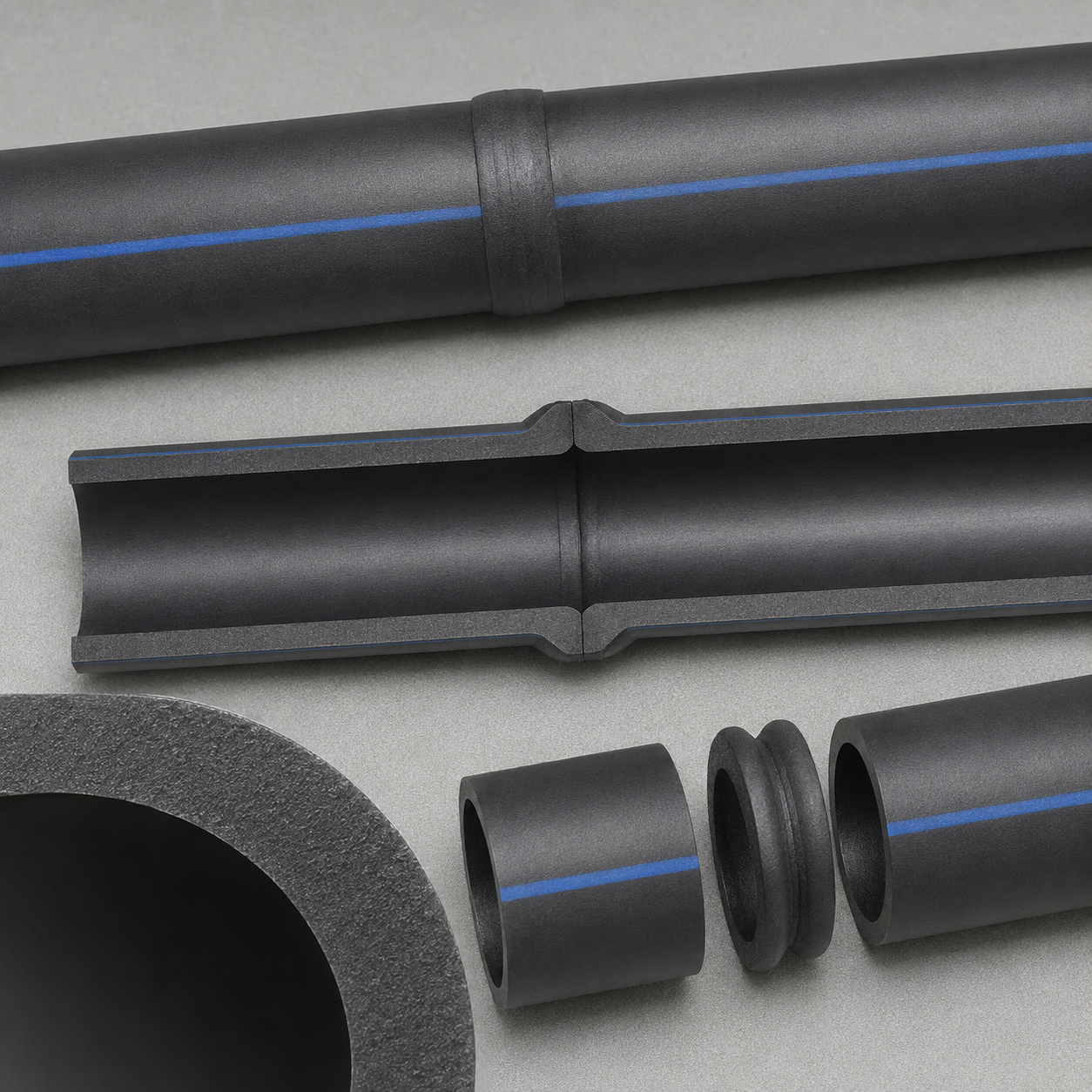
HDPE pipe · TH-01
Technical description
The HDPE PE100 DN110 PN10 pipe is intended for medium-diameter networks conveying water and other compatible fluids under pressure. PE100 identifies the material class, DN110 is the nominal outside diameter, and PN10 indicates a reference nominal pressure under standardized conditions. Actual design pressure must consider temperature, service life, transients, and operating conditions.
The system offers corrosion resistance, flexibility, and the ability to form continuous pipelines through butt fusion or electrofusion. These properties support use in buried or above-ground lines, agricultural networks, drainage, and industrial services. The pipe must be assessed with fittings, valves, anchors, crossings, and transitions because accessories and material changes affect installation and operation.
Reference sheet
Specifications
- Material
- PE100 (MRS 10 MPa)
- Nominal diameter
- 110 mm
- Nominal pressure
- 10 bar (SDR 17)
- Wall thickness
- 6.6 mm
- Dimensional standard
- ISO 4427 / ISO 4437
Use criteria
Recommended application
Conveyance of potable water, leachate, tailings, and acid mine drainage in buried or above-ground systems.
The available route also determines section lengths and the space needed to execute joints.
Relevant characteristics
Product contribution
- Fusion-joined system.
- Resistance to corrosion and abrasion.
- Flexibility for project routes.
Typical uses
System applications
- Water networks
- Drainage lines
- Leachate conveyance
- Industrial services
Selection criteria
Required information
- Flow, pressure, and operating transients.
- Fluid, concentration, and temperature.
- Length, route, elevations, and accessories.
- Buried or above-ground condition and required tests.
Installation and coordination
Execution considerations
Lengths or coils are received while avoiding impacts, cuts, and contamination of the ends. Alignment, cleanliness, ovality, and equipment condition are reviewed before fusion. The joining procedure must control temperature, pressure, and time and maintain joint traceability when required by the project. Subsequent handling must avoid loading joints that are still hot.
For buried installation, the trench, bedding, sidefill, and compaction matter. For above-ground lines, supports, expansion, radii, and protection from traffic or equipment are reviewed. A quote requires length, route, flow, pressure, fluid, accessories, installation type, location, access, and planned tests.
Frequently asked questions
Before requesting a quotation
- Does PN10 mean it can always operate at 10 bar?
- Not necessarily. PN10 is a nominal classification under defined conditions. Allowable system pressure must be adjusted for temperature, duration, transients, fluid, joints, and applicable design criteria.
- Is it supplied in coils or straight lengths?
- For DN110, both formats may be available depending on the manufacturer and dimensional ratio. Coils reduce some joints, while straight lengths can simplify transport and handling at certain access points.
- What is the difference between butt fusion and electrofusion?
- Butt fusion joins heated ends using a plate and controlled pressure. Electrofusion uses fittings with embedded heating elements. The choice depends on diameter, geometry, workspace, repair needs, and project specification.
Next step
Confirm compatibility before purchasing
We review application, quantities, supply format and installation requirements.