



Nonwoven geotextile 200 g/m²
UV-stabilized, needle-punched polypropylene with tensile and puncture resistance.
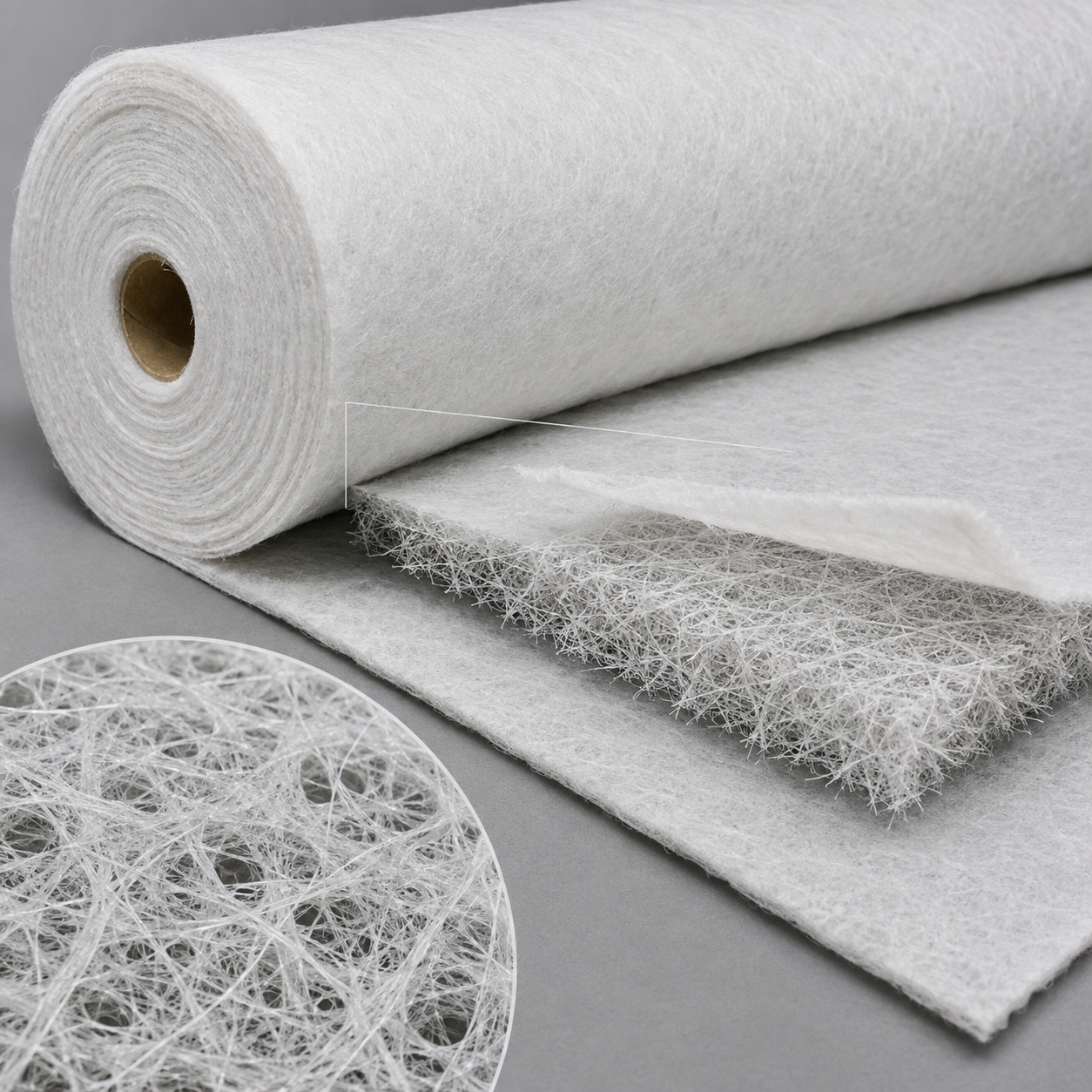
Geotextile · GT-01
Technical description
The 200 g/m² nonwoven geotextile is a permeable material made from needle-punched polypropylene fibers. It is integrated into earthworks and waterproofing systems to separate materials, provide filtration, protect sensitive surfaces, or support drainage performance. Its flexible structure adapts to moderate irregularities and distributes localized loads during construction.
Mass per unit area helps identify the product but is not enough to establish suitability. Selection must also consider tensile and puncture resistance, apparent opening size, permeability, and expected durability. For geomembrane protection, the gradation of the support or cover matters; for filtration, the relationship between geotextile porosity and soil particles affects fine-particle retention and water flow.
Reference sheet
Specifications
- Material
- Polypropylene
- Mass per unit area
- 200 g/m²
- Thickness
- 1.6 mm (a 2 kPa)
- Tensile strength
- ≥ 14 kN/m (ASTM D4632)
- Permeability
- ≥ 0.1 cm/s (ASTM D4491)
- Apparent opening size
- ≤ 0.21 mm (AOS, ASTM D4751)
Use criteria
Recommended application
Protection and separation layer beneath geomembranes, subgrade reinforcement, and drainage systems in fills and roads.
Continuity between panels and care during covering are as important as the roll's declared properties.
Relevant characteristics
Product contribution
- Separates materials with different gradations.
- Filters while allowing water to pass.
- Protects membranes against puncture.
Typical uses
System applications
- Protection beneath geomembrane
- Drains and filters
- Road subgrades
- Layer separation
Selection criteria
Required information
- Primary function within the section.
- Soil gradation and hydraulic condition.
- Mechanical loading during installation and service.
- Widths, overlaps, and total supply area.
Installation and coordination
Execution considerations
The roll is deployed on a prepared surface, avoiding contamination by mud, sharp materials, or unnecessary traffic. Panels are placed with the overlaps or joints defined by the project and must remain stable until the next layer is installed. When protecting a geomembrane, handling must prevent tools, machinery, or aggregates from damaging the underlying barrier.
Supply quantities consider net area, overlaps, cutoffs, and project geometry. The request should state the primary function, soil type, adjacent layers, hydraulic condition, expected loads, preferred width, and installation schedule. GEOALISI can coordinate the material with the geomembrane system and its execution.
Frequently asked questions
Before requesting a quotation
- Does mass per unit area alone define geotextile quality?
- No. Two products with the same mass per unit area may differ in strength, thickness, permeability, and apparent opening size. Comparison must use the properties required for separation, filtration, or protection.
- Can it be installed directly beneath a geomembrane?
- Yes, when the design specifies it as a protection or separation layer. Its mass and strength must be related to support conditions, potentially sharp elements, and the loads the system will receive.
- How is the required quantity calculated?
- The calculation begins with the geometric area and adds overlaps, returns, anchors, and cutting losses. A drawing with dimensions and details enables a more representative quantity takeoff and suitable roll widths.
Next step
Confirm compatibility before purchasing
We review application, quantities, supply format and installation requirements.