



Sodium bentonite GCL 4000 g/m²
Natural sodium bentonite encapsulated between needle-punched geotextiles; self-sealing in the presence of moisture.
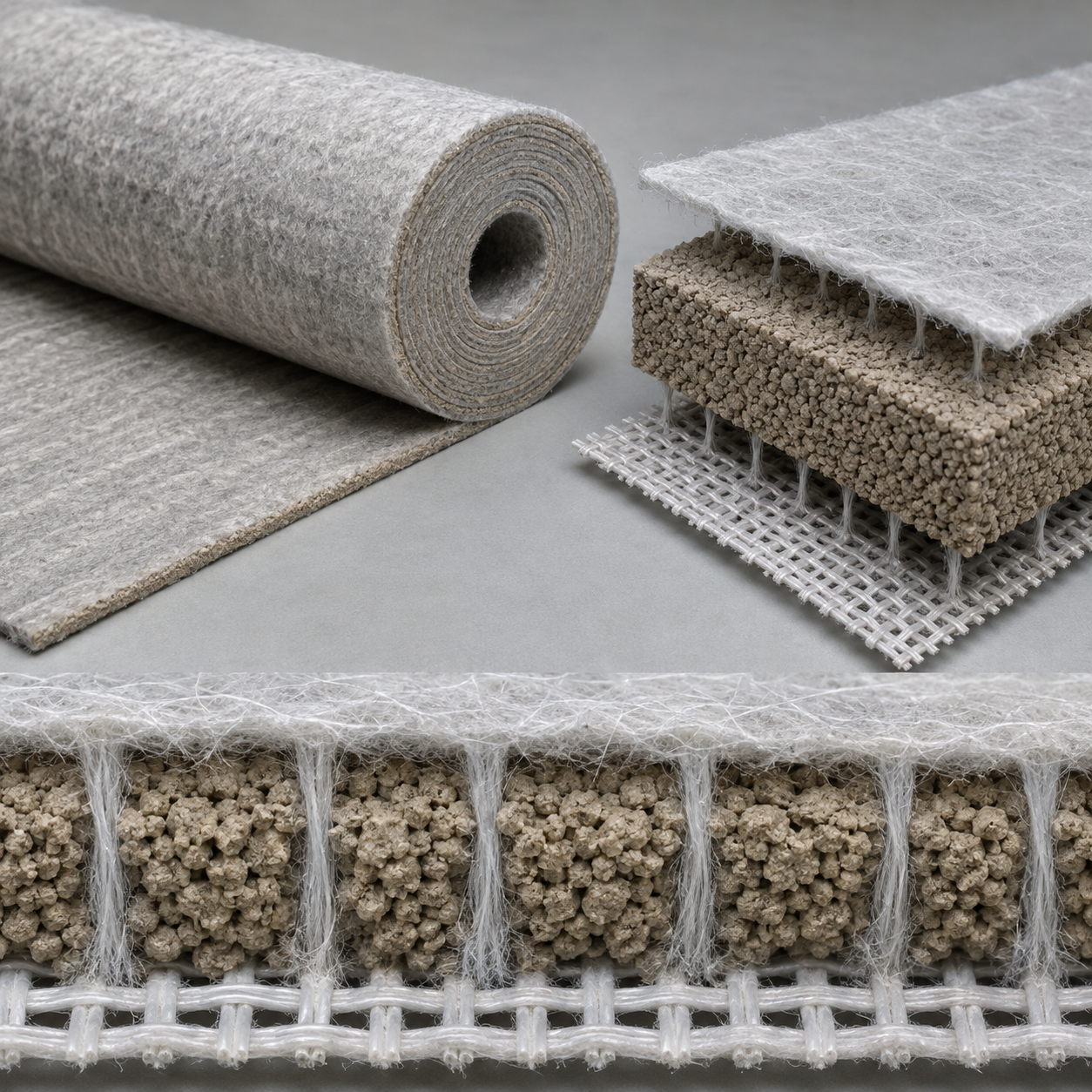
GCL · GC-01
Technical description
The 4,000 g/m² sodium bentonite GCL combines a layer of expansive clay with geotextiles that facilitate transport and installation. When hydrated under confinement, the bentonite develops a very low-permeability barrier. Depending on project design and conditions, this solution provides a uniform mineral layer with less thickness than a traditional compacted-clay barrier.
Its performance is linked to bentonite quality, mass per area, the geotextile bonding method, confinement, and chemical compatibility. Hydration, overlap continuity, and the absence of damage before covering also matter. GCL can complement a geomembrane in composite systems, where each layer responds to different containment and protection mechanisms.
Reference sheet
Specifications
- Bentonite type
- Natural sodium
- Bentonite mass
- ≥ 4000 g/m²
- Permeability
- ≤ 5 × 10⁻¹¹ m/s (ASTM D5887)
- Tensile strength
- ≥ 8.0 kN/m (ASTM D6768)
- Peel strength
- ≥ 360 N/m (ASTM D4632)
Use criteria
Recommended application
Low-permeability barrier beneath geomembranes in landfills, mining ponds, and hydraulic projects; a replacement or complement for compacted clay.
The covering sequence must be coordinated so no areas remain vulnerable to moisture or site traffic.
Relevant characteristics
Product contribution
- Thin mineral barrier.
- Localized self-sealing capacity.
- Panel installation with defined overlaps.
Typical uses
System applications
- Landfills
- Mining ponds
- Secondary containment
- Hydraulic works
Selection criteria
Required information
- Liquid chemistry and bentonite compatibility.
- Support, confinement, and final cover.
- Hydration condition before service.
- Treatment of overlaps, edges, and penetrations.
Installation and coordination
Execution considerations
The supporting surface must be graded and free of elements that could puncture the roll. Panels are deployed with the specified orientation and overlaps while keeping the joint area clean. Edges, corners, penetrations, and repairs require additional bentonite or specific details. The material must be protected from premature hydration, heavy rain, traffic, and prolonged exposure before cover is installed.
Preparing the supply requires the area, geometry, complete barrier system, support condition, contained fluid, and construction sequence. Access and equipment for handling heavy rolls must also be considered. GEOALISI can coordinate the GCL with geomembrane, geotextiles, logistics, and installation to maintain continuity between layers.
Frequently asked questions
Before requesting a quotation
- Does GCL always replace compacted clay?
- No. It can replace or complement compacted clay when engineering allows, but the two solutions have different support, thickness, confinement, and control requirements. Equivalence must be assessed for each containment system.
- Can it remain exposed after deployment?
- Exposure must be minimized and premature hydration avoided. Scheduling deployment and covering is important to preserve material condition and prevent damage caused by weather or traffic.
- Is it installed with geomembrane?
- Yes, it is commonly used as part of a composite barrier. Layer order, details, and compatibility depend on the design. The geomembrane provides a polymeric barrier, while GCL adds a complementary mineral barrier.
Next step
Confirm compatibility before purchasing
We review application, quantities, supply format and installation requirements.