



Polylock insert for HDPE geomembrane
HDPE profile with a welding channel and anchoring surface for embedding in fresh concrete.
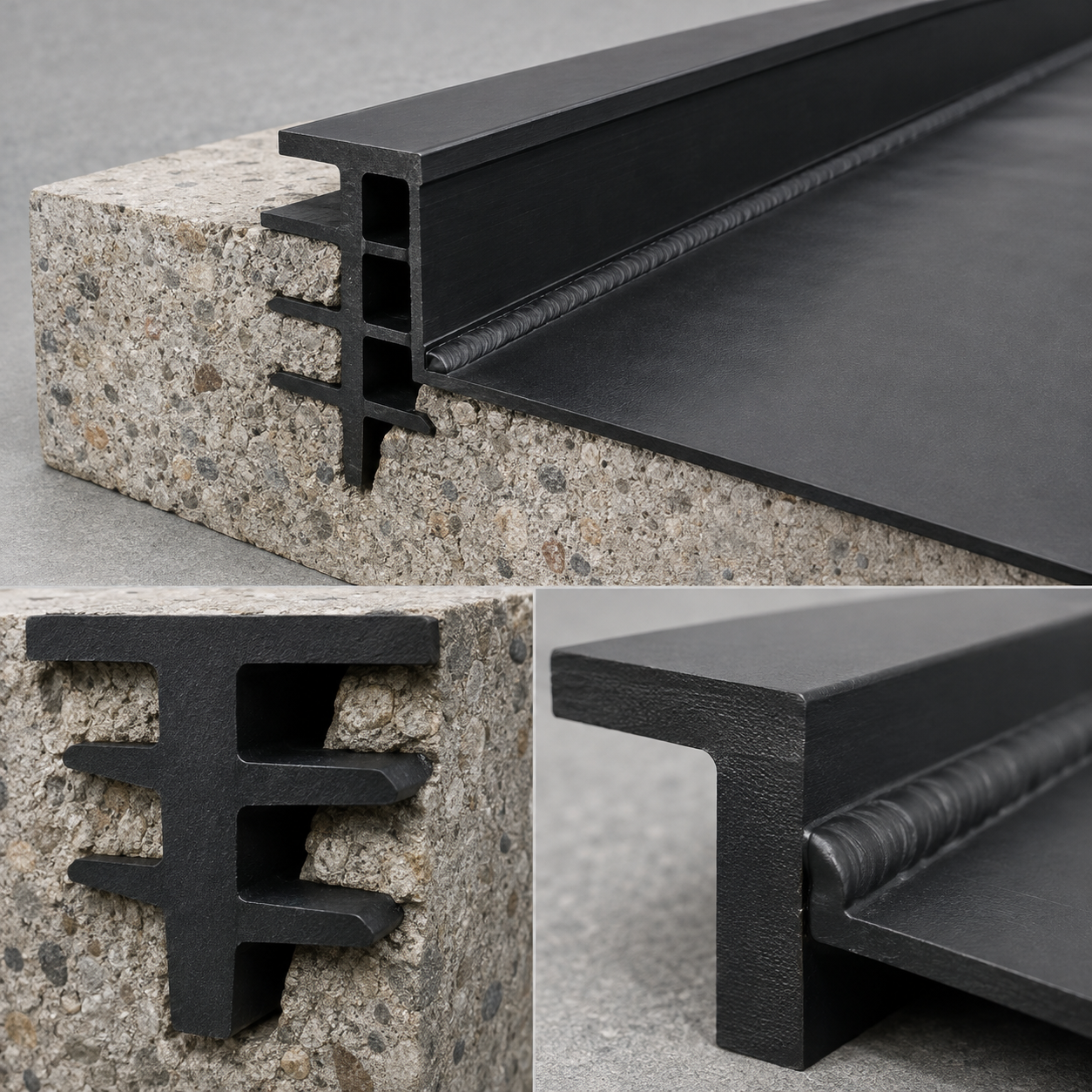
Accessory · AC-01
Technical description
The Polylock insert is an HDPE profile designed to create a weldable surface on concrete elements. Part of the profile is embedded during concrete placement, while the exposed face allows the geomembrane to be joined by extrusion welding. This resolves the transition between a flexible barrier and a rigid structure without relying only on surface fasteners.
It is used on walls, slabs, chambers, sumps, and perimeters where the geomembrane must terminate against concrete. The result depends on the profile as well as its position, continuity, and anchoring within the element. Corners, changes in direction, splices, and intersections with other pieces must be defined before concrete placement because correcting the position after curing can be complex.
Reference sheet
Specifications
- Material
- HDPE
- Bar length
- 2.0 / 3.0 m
- Height
- 50 / 75 / 100 mm
- Fastening
- Embedded in fresh concrete
Use criteria
Recommended application
Perimeter anchoring of geomembranes to concrete walls and slabs in ponds, reservoirs, and landfills.
Early coordination prevents interruptions between disciplines and helps maintain a continuous weldable line. It also allows sections, transitions, and quantities to be prepared before the concrete work restricts access.
The layout must be documented to verify the position before closing the formwork.
Relevant characteristics
Product contribution
- Weldable transition between concrete and liner.
- Anchoring integrated into the structural element.
- Continuity at perimeter transitions.
Typical uses
System applications
- Pond walls
- Concrete slabs
- Chambers and sumps
- Structural transitions
Selection criteria
Required information
- Detail, location, and total transition length.
- Membrane and associated welding procedure.
- Concrete placement and installation sequence.
- Required corners, splices, and prefabricated pieces.
Installation and coordination
Execution considerations
The profile is fixed to the formwork or reinforcement according to the detail, keeping the weldable face protected and aligned. Movement, deformation, or contamination must be prevented during concrete placement. After stripping the formwork, continuity, position, and surface condition are inspected before positioning the geomembrane and performing extrusion welding.
The joint requires preparation of the profile and sheet, geometry accessible to the equipment, and enough space to verify the weld bead. A quote requires drawings, sections, total length, profile height, number of corners, concrete placement sequence, geomembrane type, and installation dates. Special pieces can be coordinated before shipment.
Frequently asked questions
Before requesting a quotation
- Is Polylock installed before or after concrete placement?
- The profile must be embedded in fresh concrete, so its position is coordinated before concrete placement. The face intended for welding remains exposed to receive the geomembrane later.
- Can it be fastened to existing concrete?
- The described product is designed as an embedded insert. Existing structures require another termination detail or complementary solution to be assessed, considering loads, watertightness, access, and material compatibility.
- How are corners resolved?
- Transitions and pieces can be prepared according to project geometry. The important point is to maintain anchoring continuity and an accessible surface for welding the membrane without concentrating stress or leaving unfinished areas.
Next step
Confirm compatibility before purchasing
We review application, quantities, supply format and installation requirements.