



EPDM penetration boot
Prefabricated piece that seals the intersection between a pipe or duct and the EPDM membrane.
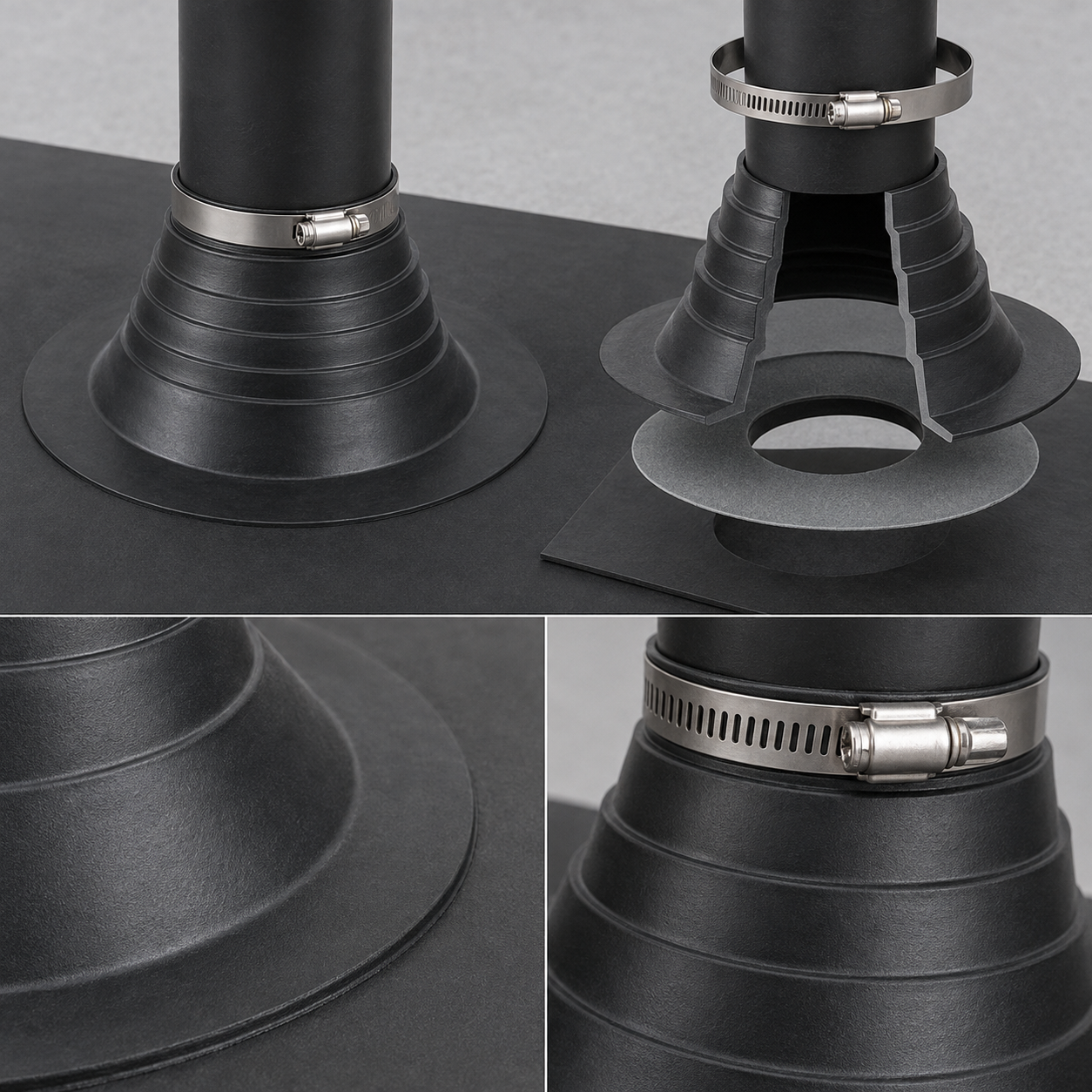
Accessory · AC-02
Technical description
The EPDM penetration boot is a flexible piece used to waterproof the transition between a membrane and a pipe, duct, or vent. Its geometry wraps the element passing through the surface and forms a gradual transition, reducing folds and stresses that would appear if the detail were resolved only with a flat sheet.
Selection depends on the actual outside diameter, inclination, expected movement, and compatibility with the main membrane. Clamps, sealants, and the base joining method must also be defined. Although the piece is prefabricated, detail performance requires a stable support, clean surfaces, and enough space to work around the entire penetration.
Reference sheet
Specifications
- Material
- EPDM
- Pipe diameters
- 25 a 200 mm
- Fastening
- Stainless-steel clamps + sealant
Use criteria
Recommended application
Sealing pipe, duct, and vent penetrations through roofs and walls waterproofed with EPDM membrane.
On roofs with multiple utilities, each penetration should be recorded and grouped by diameter, material, and geometry. This survey reduces improvisation, facilitates accessory supply, and allows the finishing and inspection sequence to be organized.
Available clearances around each duct affect access for properly executing the complete seal.
Relevant characteristics
Product contribution
- Adaptable seal around penetrations.
- Prefabricated detail for repeatable geometries.
- Integration with clamps and sealant.
Typical uses
System applications
- Pipe penetrations
- Roof ducts
- Vents
- Wall transitions
Selection criteria
Required information
- Actual diameter and penetration material.
- Angle and location relative to the membrane.
- Compatibility with the waterproofing system.
- Expected movement, fasteners, and specified sealant.
Installation and coordination
Execution considerations
The penetration must be firm, clean, and separated from edges or other elements that prevent work. The boot is trimmed or selected to fit the diameter without being forced. Its base is integrated with the membrane using the compatible system, and the upper portion is sealed around the pipe with the elements defined for the detail.
Before completion, continuity, seal contact, fasteners, and possible stress points are reviewed. Preparing the solution requires the pipe diameter and material, a photograph or drawing, penetration angle, membrane type, support condition, and quantity. Special diameters may require different fabrication or detailing.
Frequently asked questions
Before requesting a quotation
- Is the size defined by the pipe's nominal diameter?
- The actual outside diameter should be used because it may vary by material, class, and configuration. An incorrect size can prevent proper fit or create stress and deficient seals.
- Can it be used on an inclined penetration?
- Inclined penetrations can be resolved, but the geometry must be reviewed. The angle changes the base shape and stress distribution, so a standard piece may not be suitable.
- Is the clamp enough to waterproof the penetration?
- No. The clamp forms part of the upper seal, but the base must also be properly integrated with the membrane using compatible materials. The full perimeter must remain accessible for execution and inspection.
Next step
Confirm compatibility before purchasing
We review application, quantities, supply format and installation requirements.